


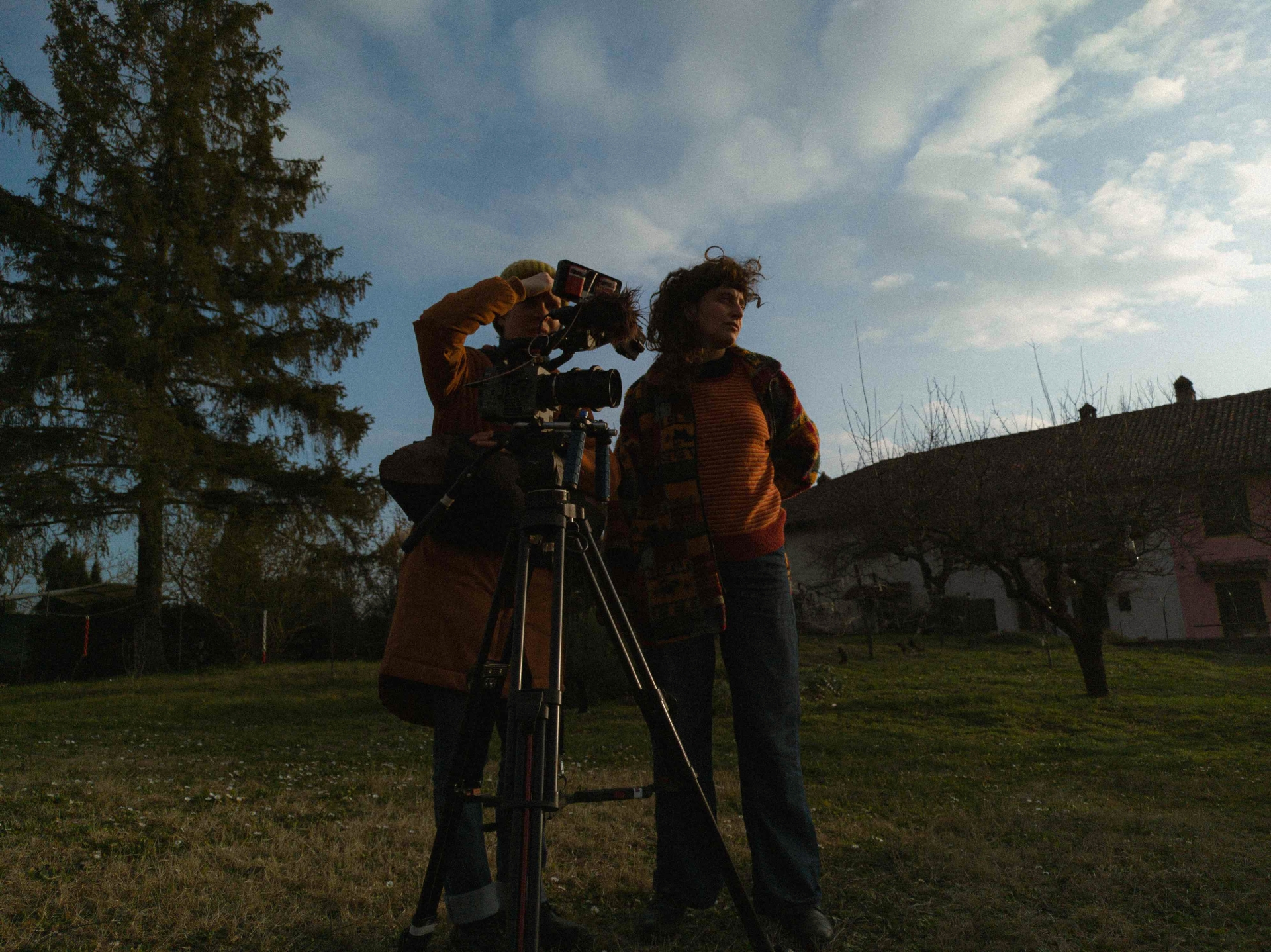
This model, which for ZeLIG is foundational, is today increasingly recognised by the European industry, where the development paths of the most interesting films take shape in collaborative contexts, within residencies and training programmes. It is a model that on its own is not enough to form a gaze: that would be an illusion, and it would be unfair to those who form that gaze elsewhere, in difficult contexts and through constant confrontation with practical, everyday experiences of life. It is however one of the conditions that make it possible: it is no coincidence that a film born this way finds space in Nyon, in Zagreb, in Bellaria.
And yet, precisely today, while ZeLIG and other training centres are gathering the fruits of a way of working that has a history, filmmaking is going through an epochal shift that concerns everyone, coinciding with the consolidation, in the market and in society at large, of artificial intelligence.
Generative and non-generative artificial intelligence has entered production processes, from development to post-production, and forcefully into image-making as well. I read with great interest the interviews Steven Soderbergh gave to Filmmaker Magazine and Deadline, talking about his new film John Lennon: The Last Interview, recently presented at Cannes (interviews given before the festival screening): 10 minutes of the film, out of one hundred, are entrusted to images generated with artificial intelligence tools. What is interesting is not the running time, but the "theoretical framework" with which Soderbergh justifies their use: the American director distinguishes between literal space and dream space, that is, the photographic and sound archive on Lennon illustrates what has a referent, while the generated image intervenes only in those abstract, philosophical passages where a referent does not exist and where archival material would not work except by forced analogy. I want to underline here that I have not seen the film, and that this aspect (not having seen it) is not necessary for the reflection shared here: I am not interested in evaluating the film, but in discussing the theoretical framework with which Soderbergh has justified the tool.
The distinction between literal space and dream space deserves attention, in my view, and one observation. The dream space is not an invention of artificial intelligence. Cinema has been crossing it for decades, every time it has had to give image to what could not be filmed. Chris Marker, in La jetée, built a science-fiction photo-roman set in a dystopian future, primarily through the editing of photographs accompanied by a voice-over; Harun Farocki worked all his life on the reuse of archives as a way of questioning what images do not show; Anca Damian, in Crulic: The Path to Beyond, told through various animation techniques the story of a young Romanian man who died in prison on a hunger strike, where no image could have served the narrative. These are different solutions, of course, and none equivalent to those of artificial intelligence. But they point to something important, I think: the problem posed by Soderbergh (how to give image to the non-referent) is one of the constitutive questions of cinema, and the history of this art offers tools, examples, compasses.
This is where the point that most interests me comes in. Every great technical revolution in cinema (the arrival of sound, the arrival of digital, today artificial intelligence) has transformed the way films are made. It did not leave it the same, and it will not leave it the same. What has changed, each time, are authorial postures: what the author does, what the machine does, where the decision lies, where responsibility lies. And every time, schools and training centres have been among the places (not the only ones, of course) that have tried to form, first of all, the capacity to think cinema: the technical instrument can be learned, while the gaze is formed, above all through experience, and is formed slowly, in relation, with a community that watches films together, discusses them, takes them apart, makes them its own.
Artificial intelligence is not a neutral tool: it pre-decides many things if one does not know what one is asking of it, and above all, it introduces its own regime of literalness even when authors try to push it in another direction. Soderbergh himself notes that to use it one would need "a PhD in literature": the prompt is a writing practice, and those who write bad prompts get weak images. But the real problem is not the prompt: it is knowing where, why and what one wants to make appear in the space of the film. It is knowing when an image is needed and when it is one too many. This awareness does not come from the tool. It comes from the history of cinema, from the films seen, from the films made, from the conversations inside a classroom, after a screening, inside an editing room.
The award to Bianca, Esther and Elisa, and to the working group that accompanied Torneranno i lupi, tells us that the gaze, when formed with care and time, crosses festivals, geographies, and critical sensibilities. It also tells us, indirectly, that cinema will continue to need people capable of deciding what to do with the tools at their disposal: where to point cameras and microphones, when an image generated from a prompt truly serves the film and when it is one too many, and why. The more powerful the tools become, the more precious this capacity becomes.
This is why we stubbornly continue to make school this way.